FutureSkills plugs into the curriculum you already teach. Students build judgment and authorship as they use AI through a review studio that your teachers run on the writing they already assign. Built for educators. No student logs in. No student PII crosses our boundary.
Most students may not become engineers. All students will become decision-makers — in classrooms, in careers, in the systems they'll shape. FutureSkills builds the judgment infrastructure for that future, organized around three competencies that prepare people to think clearly in AI-shaped environments.
01
Fluency
Applied AI Fluency
Students develop a working understanding of how AI generates outputs, what shapes those outputs, and where limitations appear. They learn to evaluate credibility, question assumptions, and stay engaged in the thinking process as tools become more capable.
How systems work & break
02
Judgment
Ethical Judgment
Students explore how AI systems reflect human values, priorities, and constraints. Through real scenarios, they build the ability to make decisions that account for both immediate outcomes and broader implications — for themselves, their peers, and the systems they're part of.
Fairness, Risk & Impact
03
Leadership
Applied Leadership
Most students won't become engineers. All students will become decision-makers — in classrooms today, in careers and civic life tomorrow. They develop the ability to apply AI in ways that align with who they are and what they're trying to build.
Aligning tech with values
ABOUT
Judgment infrastructure for the AI era.
FutureSkills is an edtech company building the judgment infrastructure for how students, educators, and decision-makers think and act in AI-assisted environments. We co-design curricula with educators, translating what works into shippable artifacts while protecting the human capabilities that ultimately shape how technology is used.
Beneath our work sits a pedagogical framework that realizes our competencies into something any educator can teach. It emerged from co-design with one of our committed educator partners — and, in part, was named by her in real time in the classroom.
Three values: Agency, Awareness, and Human Grounding. The work rests on a single conviction — judgment can be taught — and on the practical claim that classrooms need structure at the lesson level, not another tool.
VALUE01
Agency · Students own their story, their decisions, and their writing.
VALUE02
Awareness · Students understand what AI can and cannot do — and apply that knowledge.
VALUE03
Human Grounding · Human judgment, including peers', is the final measure of voice.
Who This Is For
Built with the people closest to the change.
We work with leaders, educators, and partners who want a more structured way for AI to show up in learning without losing what makes the work human. K-12 classrooms are where we're proving the framework; the judgment infrastructure scales beyond them, into professional contexts, civic life, and the systems decision-makers will shape.
01
Leadership
Schools & Leadership
Principals, assistant principals, district leaders, and education industry leaders and influencers looking to introduce AI in a way that strengthens learning and builds judgment, voice, and agency across the institution.
Institutional Strategy
02
Teachers
Educators
Especially rockstar educators willing to go above and beyond to integrate new approaches into their classrooms. We look for practitioners who want practical, classroom-ready frameworks without having to become technical AI experts.
Classroom Practice
03
Ecosystem
Partners & Organisations
Research institutions, cross-sector corporations, philanthropic funders, edtech/education/technology collaborators, and civic and policy organizations focused on AI literacy and the future of learning. Essentially, any organization whose environment is being reshaped by AI.
Systemic Impact
Why Now
Students are already using these tools. The question is how.
Students are engaging with AI daily, often with no clear guidance on when to rely on it, how to question it, or where their own thinking should remain central. This creates a gap in how students learn to think alongside these systems, quietly diminishing their agency and voice.
Schools are being asked to respond to this shift in real time, with limited shared language and few classroom-ready models for what responsible use should look like. Most educational and edtech companies are racing to scale teacher training. What's missing is specificity at the lesson level: structured handouts that produce evidence and language students can recognize and apply, and artifacts that capture judgment in real time.
FutureSkills exists to support that transition with clear classroom-ready frameworks that provide a structured way to keep human reasoning visible, while respecting what great relational teaching already does.
Without structure
Cognitive Risk
Thinking becomes easier to outsource
Without structure, critical engagement and reasoning are replaced by automated outputs - weakening the very skills schools are trying to build.
Identity Risk
Voice becomes harder to define
The distinction between student authorship and AI-generated content becomes harder to define and harder to defend.
Governance Risk
Decision-making becomes reactive
Without clear frameworks and reflection protocols, AI adoption is driven by the tools themselves rather than the learning goals of the institution.
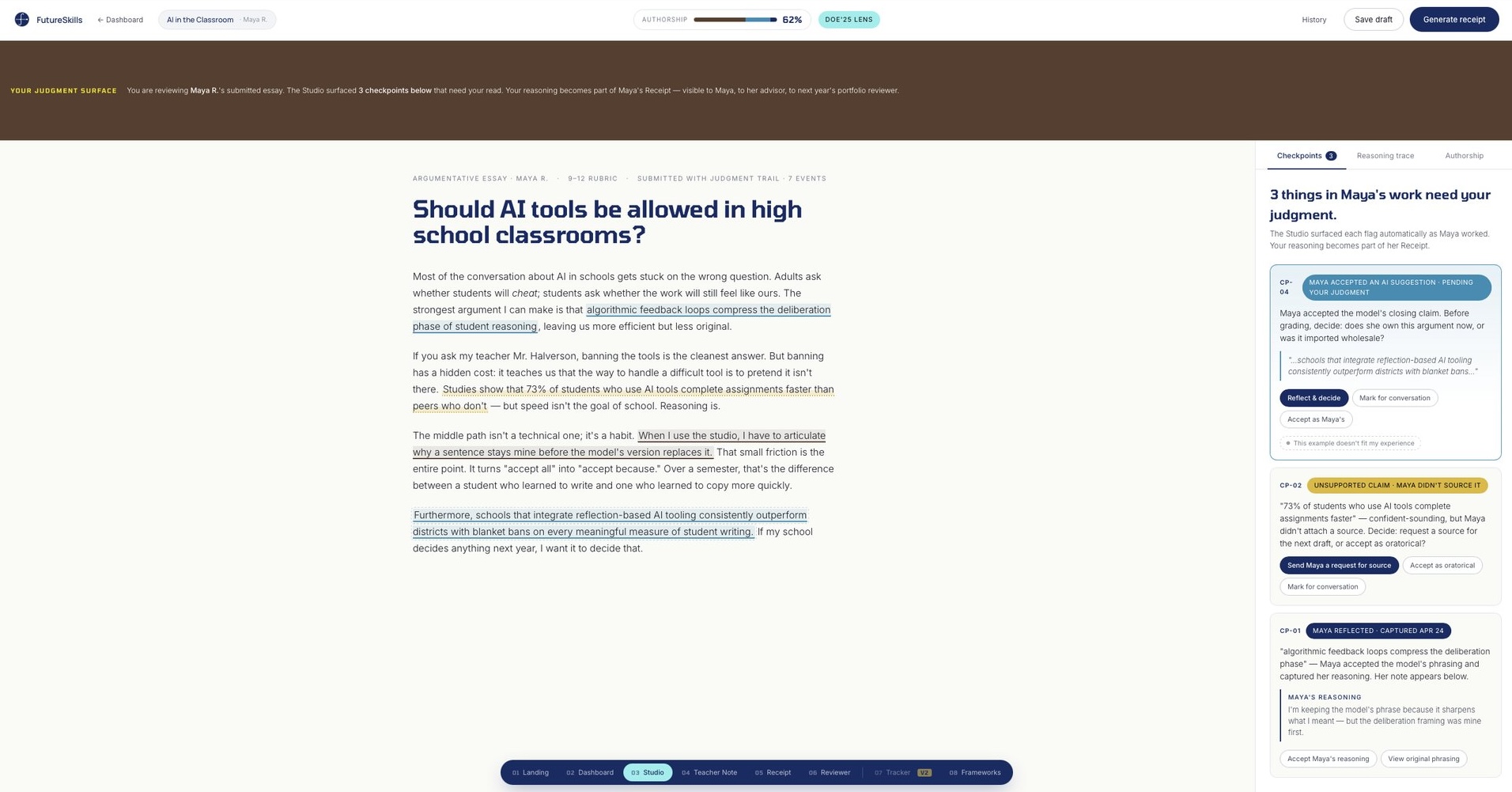
The Judgment Review Studio · v1 prototype in active build
How We Work
Four commitments. Four instruments. One framework.
Before building any tools, we partnered with intentional school admins and educator leads to design conditions for judgment to develop alongside AI – and then produced instruments that make those conditions visible, durable, and measurable in real classrooms. Each commitment below is paired with the instrument that demonstrates it.
01
Make AI use visible.
Step 1 (Make AI use visible)
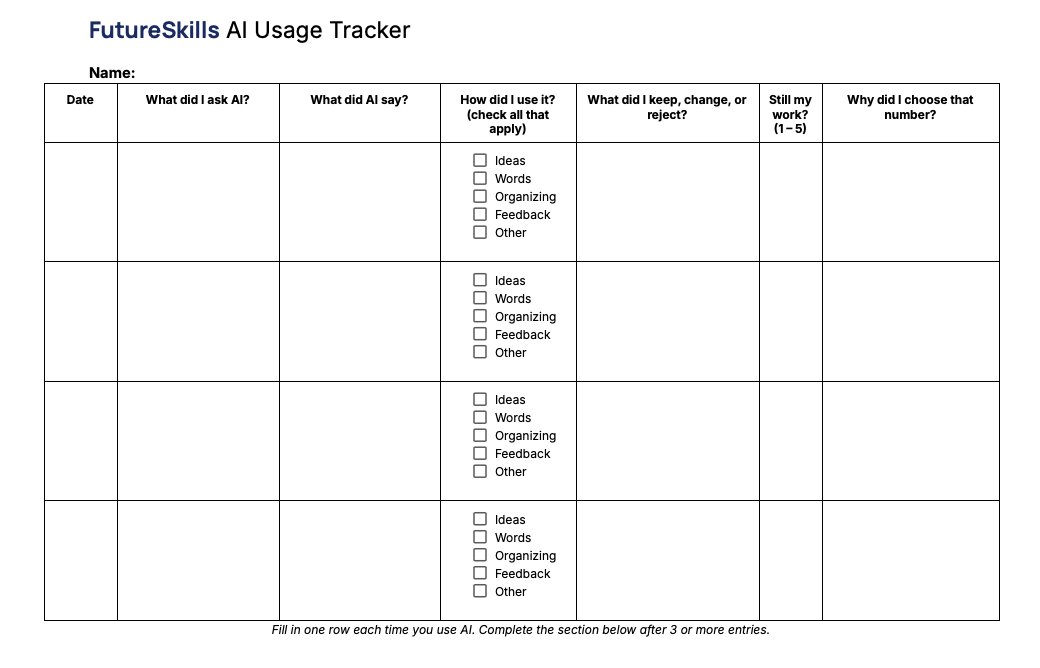
Every AI interaction is named, rated, and reflected on — turning reactive use into deliberate practice. A required prompt convention and a deliberately blunt 1–5 authorship scale make Agency a habit students can build, not a rule they have to follow. Instrument: AI Usage Tracker.
AI Tracker · New Directions, Spring 2026
02
Anchor judgment in human response.
Step 2 (Anchor judgment in human response)
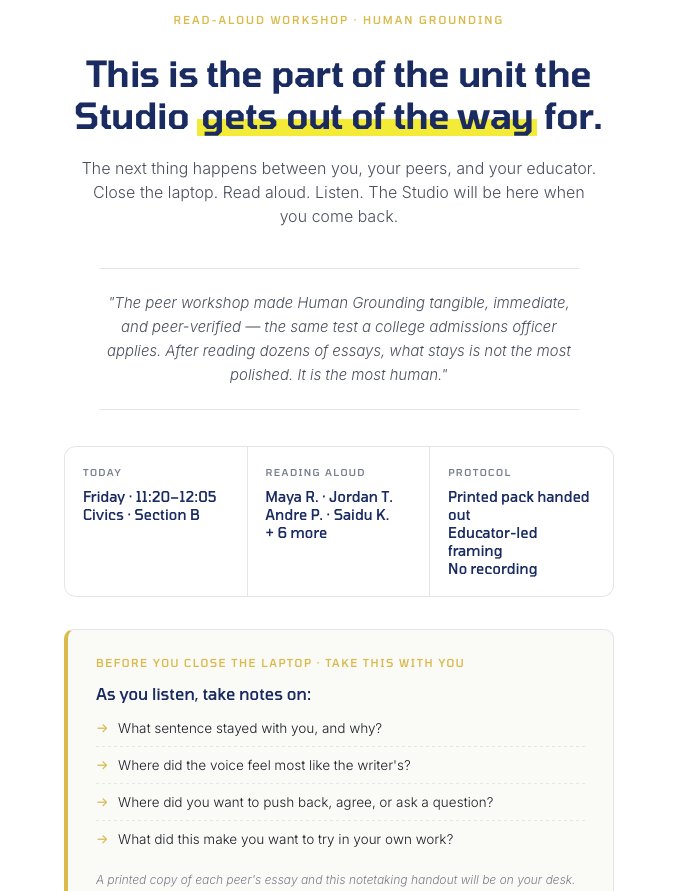
Voice, authorship, and reasoning are confirmed by real people — peers and educators — not algorithmic scores. The platform schedules the moment, prints the protocol, and gets out of the way. Instrument: Read-Aloud Peer Workshop.
Peer Review Workshop Protocol Pack · authored at New Directions
03
Bias & Safety Gallery Walks.
Step 3 (Build AI literacy from real cases)
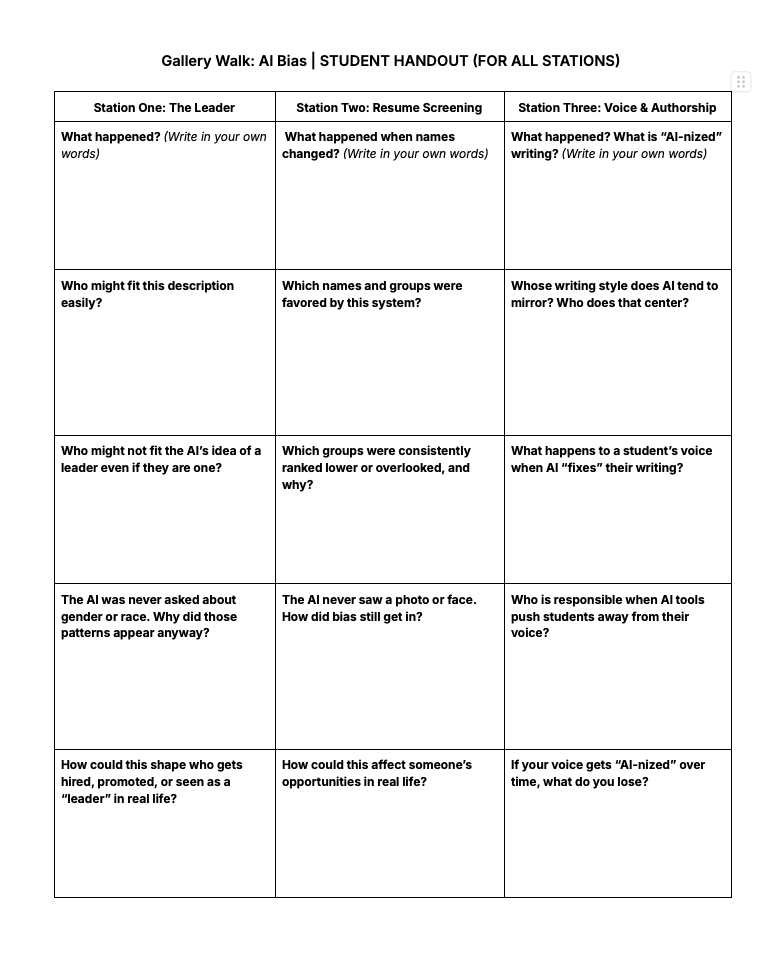
Awareness as comprehension, not exposure. Documented misidentifications, hiring-tool bias, and surveillance failures replace abstract warnings — turning AI literacy into something students can name. Instrument: Bias & Safety Gallery Walks.
Gallery Walk case cards · pilot use, Spring 2026
04
Co-design with educators from day one.
Step 4 (Co-design with educators)
The framework gets built alongside the educator, not handed to them. Our work is validated in their voice, in their classroom, on their schedule. Demonstrated: the New Directions pilot, Spring 2026.
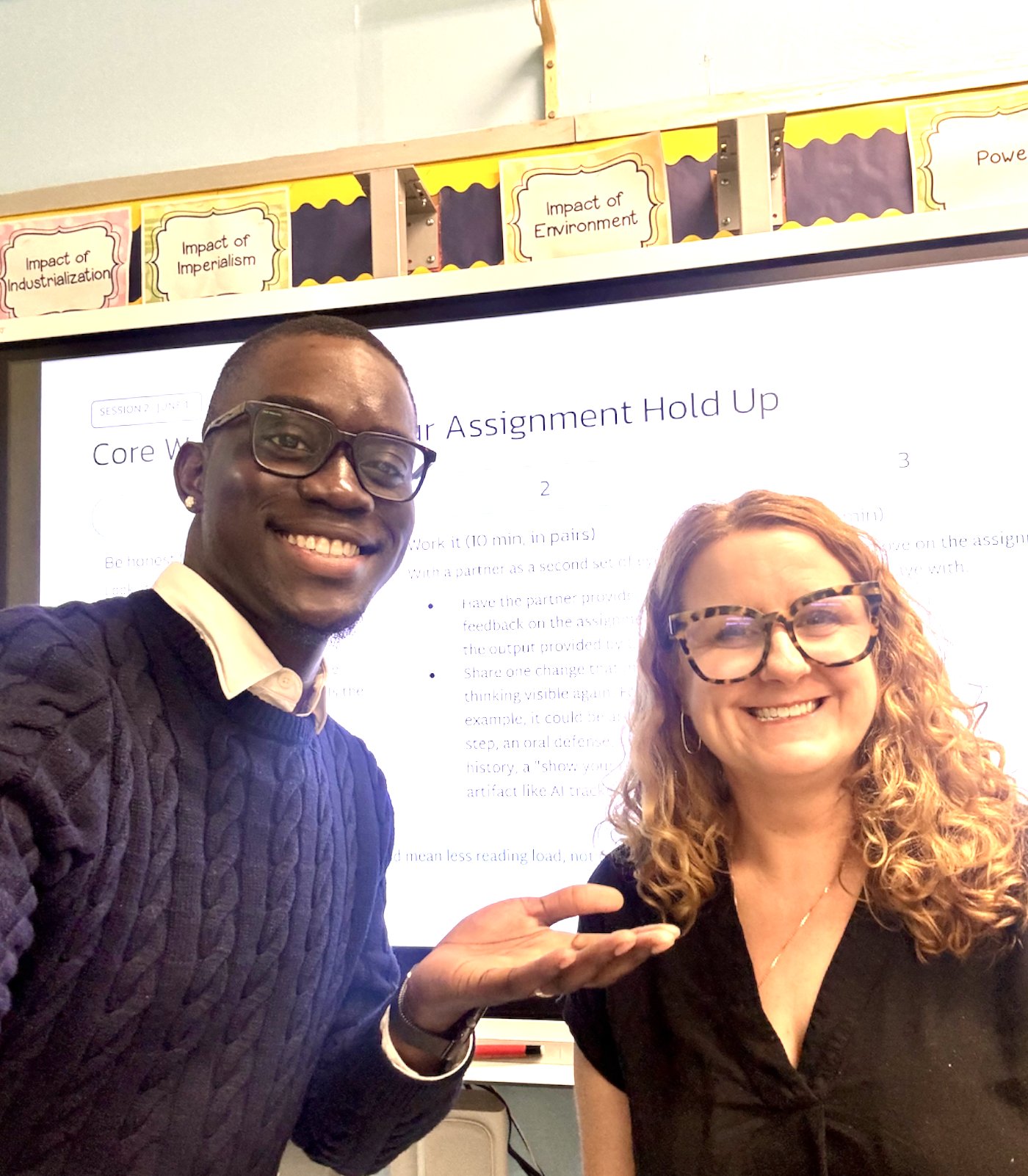
Co-design session · with K. A. Keener, NDSS
What's next
These instruments are being translated into the FutureSkills Studio, an AI-assisted learning platform designed to scale the approaches without added burden. Currently in active development for v1.
Co-design partners
Built with educators, for real classrooms.
Every part of this work was prototyped, tested, and revised inside real classrooms. We move slowly on purpose: fewer schools, deeper partnerships, and more durable, defensible artifacts.
First co-design partner · Spring 2026
New Directions Secondary School
NYC Department of Education, Transfer School, NYC
Our founding co-design pilot ran for six weeks, embedded in the school's existing college-entrance essay unit. Junior-level English students used the AI Usage Tracker, Bias and Safety Gallery Walks, the Read-Aloud Peer Workshop, and authored their own classroom AI Policy through the Policy Builder as a culminating artifact.
Jan – Jun 2026
Beam Center
Red Hook, Brooklyn · Project-based learning organization centered on student agency, design, and craft
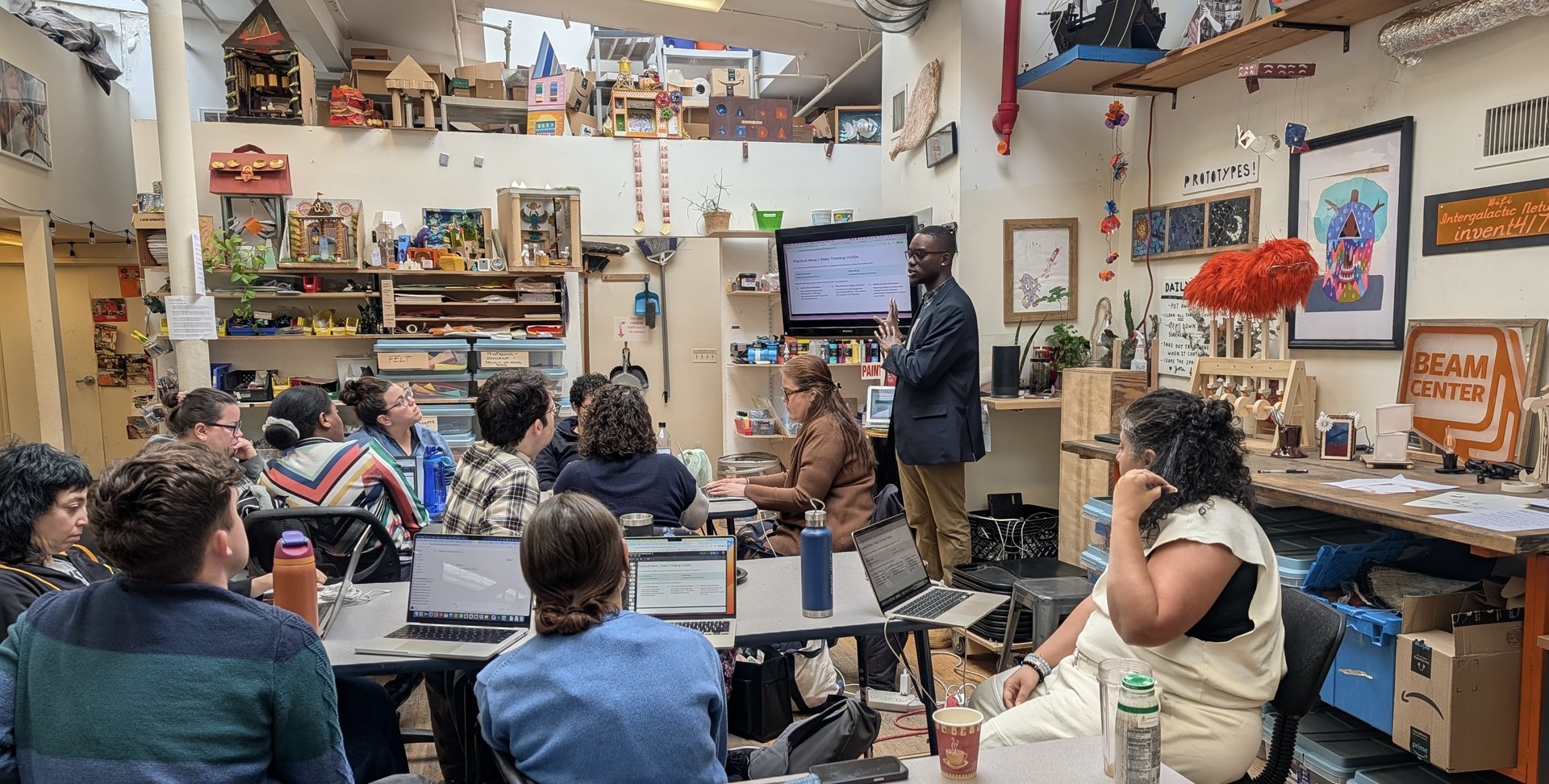
Collaborator on professional development for the Read · Write · Code Fellowship run with United Way. Together we reached 40+ ELA educators across two in-person workshops, three virtual office hours, and a series of deep-dive workshops hosted at Beam Center's Red Hook space.
Beyond the co-design pilot: 7 professional development workshops · 60+ NYC educators across multiple public high schools.
In their words
From the people building this with us.
FutureSkills brought genuine intellectual partnership to the collaboration — Kingsley arrived with real curiosity about what students needed, not a predetermined program to deliver. What made it work was that we built the curriculum together from the classroom outward rather than implementing something designed elsewhere.
K. A. Keener
[English Teacher · New Directions Secondary School]
Quote pending — partner organization
[Name]
[Role · Organization]
Quote pending — educator partner.
[Name]
[Role · School]
Quote pending — school leader.
[Name]
[Role · School]
FutureSkills brought genuine intellectual partnership to the collaboration — Kingsley arrived with real curiosity about what students needed, not a predetermined program to deliver. What made it work was that we built the curriculum together from the classroom outward rather than implementing something designed elsewhere.
K. A. Keener
[English Teacher · New Directions Secondary School]
Quote pending — partner organization
[Name]
[Role · Organization]
Quote pending — educator partner.
[Name]
[Role · School]
Quote pending — school leader.
[Name]
[Role · School]
Data Ethics
We do not record student voices. We have not. We will not.
Most ed-tech products are racing to instrument every moment of student work. Our position is the opposite: some moments are more valuable when they are not captured. We commit to a deliberate restraint about what we track and what we let stay between people.
No audio capture in v1, ever.
Our peer workshop happens in the room, between students and their teacher. The platform schedules it, prints the protocol, then disappears. No microphones, no transcripts, no metadata about what was said.
No biometric inference.
No voice analysis, no emotion detection, no stress signal mining. The platform does not infer anything about the human in the room.
No third-party access to in-room moments.
Structured peer responses captured after the workshop are subject to the privacy package. The during moment produces no platform artifact at all.
Restraint stays the default.
If we ever revisit features like voice memos, they must be opt-in, student-controlled, never used to train any model we run, and never default.
A note from the founder
I started FutureSkills because I sensed a gap in education before I had the language for it. A conversation with a close mentor about evidence-based AI gave me the phrase that locked everything into place: judgment-based infrastructure for the future of learning. That's when I knew this was what I was going to build a company around.
I've always believed in and advocated for equitable access – through business seminars at Tufts, my first education-based startup, product work, philanthropy, and classrooms I've kept returning to. While the rooms keep changing, the question doesn't: who gets to develop a voice, and what happens when institutions don't make room for theirs?
The next generation should not have to stress about being replaced by AI. They should be better builders and better decision-makers because of it. That's the cultural revolution I'm here to build.
Kingsley Udoyi
Founder & CEO, FutureSkills
Get in Touch
Start a conversation.
If you're thinking about how AI is showing up in your classrooms and want to explore a more structured approach, we'd love to connect.